
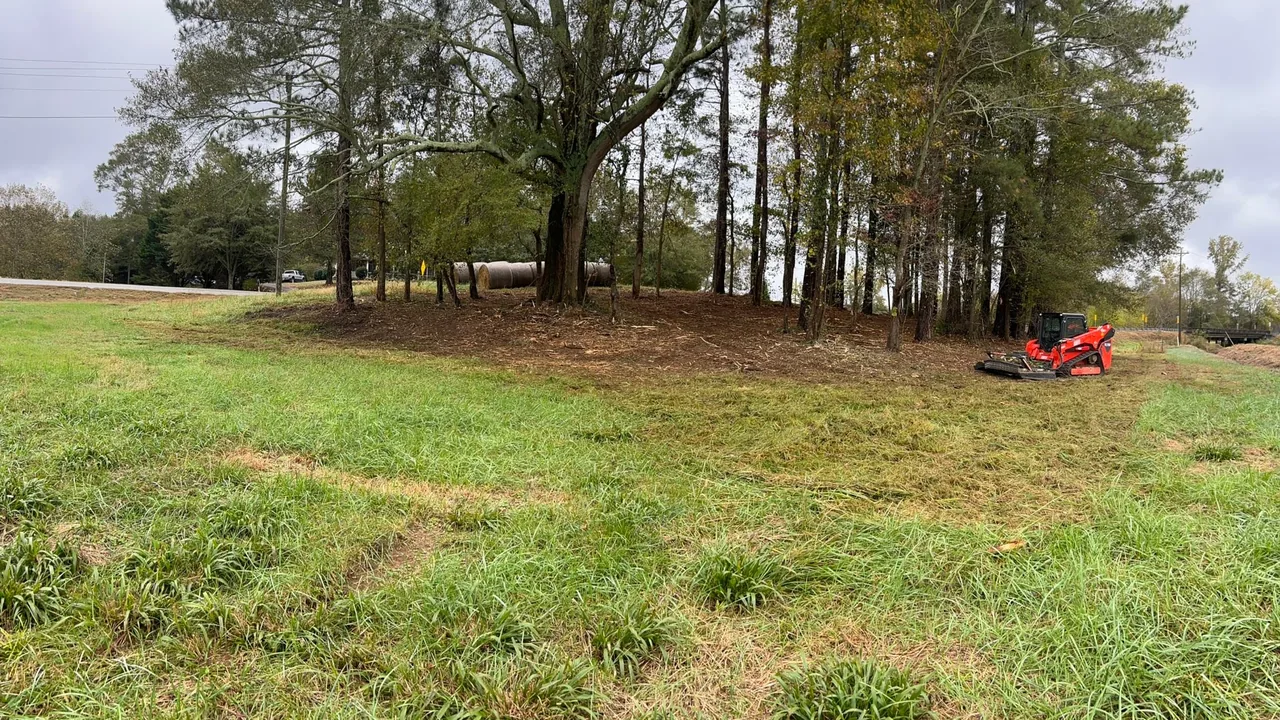
How Much Does Bush Hogging Cost in Georgia?
Published market numbers put bush hogging at about $100 an acre for open pasture, or $85 to $120 an hour. Both figures come from a 2026 national pricing guide. Farm surveys from extension services in other Southern states run lower, about $17 to $25 an acre. The University of Georgia’s farm custom rate survey has no bush hogging line.
Thick growth, saplings, rocks and slopes push any job toward the top of a range. These are market numbers, not our price list. A price for your field starts with a look at the ground. Our bush hogging service covers overgrown fields and pastures across Northeast Georgia, and every quote comes in writing.
What do cost guides and farm surveys say bush hogging costs?
Two kinds of sources publish these numbers. National cost guides price work for landowners who hire a contractor. Extension services survey custom rates, meaning what a landowner pays a hired operator who brings the machine.
| Source | Per acre | Per hour | What the number covers |
|---|---|---|---|
| National pricing guide, 2026 | About $100 | $85 to $120 | Open pasture by the acre, a tractor with a 6-foot cutter by the hour |
| National land clearing guides | $20 to $200 | Not listed | Clearing brush alone, no trees |
| Mississippi extension survey, 2024 | $20 to $25, average $22.50 | $30 to $125, average $72 | Bush hogging, 7 answers in all |
| Kentucky extension custom rates, 2024 | $17 to $25.50, average $19.50 | $80 to $125, average $95 | Bush hogging by the acre, fence rows and ditches by the hour |
| University of Georgia custom rate survey, 2024 | $11 to $57, average $22.68 | Not listed | Mowing hay (the survey has no bush hogging line) |
Georgia’s own numbers come from the University of Georgia’s 2024 custom rate survey. It drew 58 usable answers from 29 counties in heavy crop-producing regions. Its nearest job to bush hogging is mowing hay, which averaged $22.68 an acre. That lines up with the bush hogging averages from Mississippi and Kentucky.
Read the farm numbers with care. Kentucky’s guide is built on Midwest farm surveys, and only one state reported a bush hogging rate. It warns that its averages should not be used to set rates in an area. Mississippi’s guide says custom rates are often negotiable.
What drives the cost of bush hogging?
Acreage sets the base, and the ground sets the pace. The 2026 pricing guide says a 6-foot cutter covers about 2.4 to 3 acres an hour in perfect conditions. Real fields are often slower, and slow acres cost more.
- Height and thickness. Tall, thick growth slows the cutter and can take a second pass. One pricing guide lists re-cuts among the extra charges to spell out up front.
- Saplings. Young saplings and briars are normal bush hogging work. As stems thicken, the machine works harder and covers less ground.
- Terrain. Steep slopes and wet spots slow a machine down. The pricing guide says tougher ground with rocks or slopes pushes rates toward the top of its range.
- Hidden debris. Old fence wire, stumps, rocks and junk piles hide in tall grass. Hitting one can break blades, and the guide builds that risk into its minimums.
- Access. A national land clearing guide says direct road access and flat entry points cost less. Tight access can mean smaller equipment or extra trips, which adds labor time.
- Minimums. The 2026 guide says many pros set a 2 to 3 hour minimum or a flat show-up fee. On a small lot, the minimum can be the whole bill.
- Acreage. Bigger fields spread the setup across more acres. The same guide says per-acre prices can come down on big jobs.
How often does a pasture need bush hogging?
A healthy pasture may not need it at all. UGA’s forage guidelines say established perennial forages can suppress most weeds. With good forage management, they say, mowing will not be necessary. New plantings differ, and the same guidelines say to mow them every 2 to 4 weeks, depending on weed pressure.
Weedy pastures are a different story. The UGA Extension forage team says mowing is especially effective at cutting the seed broadleaf weeds make. Time the cut before the weeds go to seed. A single mowing will not control perennial weeds that spread by underground rootstocks, like thistle.
The forage team also points to causes. Its weed control steps include a stocking rate that stops overgrazing and a mower height that leaves enough stubble.
In Stephens and Franklin counties, the 2022 Census of Agriculture shows pasture as the largest use of farm land. A pasture that brush has taken over needs a reclaim cut first. After that, a cut each season, timed before weeds seed, helps keep it open. Some of our farm customers have us back each season.
When does bush hogging become forestry mulching?
It becomes mulching when saplings grow into thick brush and small trees. A brush cutter is built for tall grass, weeds, briars and young saplings. Past that point, the ground calls for forestry mulching. A mulching head grinds brush and small trees into mulch that stays on the ground.
The price moves with the tool. National cost guides put forestry mulching at about $400 to $800 an acre, or $125 to $300 an hour. A field cut each season rarely gets there, because the saplings stay small.
Privet is a common reason a field crosses over. The Georgia Forestry Commission says privet is common across all of Georgia. It forms dense thickets in fields, and birds and other animals spread its seed.
Many overgrown fields have both kinds of ground. Our track loader runs both a brush cutter and a forestry mulcher head. Each part of a field gets the tool it needs.
Fence rows grow up too. When brush has swallowed a fence, fence line clearing mulches it back so the line is open again. One national cost guide puts an overgrown fence line at $200 to $1,200, depending on how thick the growth is. Where pasture meets the woods, underbrushing clears privet and briars under the trees and keeps the canopy.
What should a written bush hogging quote include?
A written quote lets you compare prices on the same work. Look for these lines:
- The area to cut, marked on a map or flagged on the ground
- What gets cut and what stays, such as trees along a fence row
- Whether the price is per acre or per hour, plus any minimum charge
- How hidden wire or junk found during the job is handled
- Which thick patches need the mulcher, priced as their own line
How do you get a bush hogging price for your field?
The numbers above are a starting point. Your field’s acreage and what grows on it set the real price.
Wall Land Solutions does bush hogging about 60 miles around Toccoa, across Northeast Georgia. Read how our bush hogging works, then call or text (678) 776-8002. We look at the field and give you a free estimate, with the quote in writing.