
How Much Does Forestry Mulching Cost per Acre in Georgia?
National cost guides put forestry mulching at about $400 to $1,500 per acre for typical brush. Thick growth with bigger trees can reach about $2,500 per acre. Billed by the hour, a machine and operator run about $125 to $400.
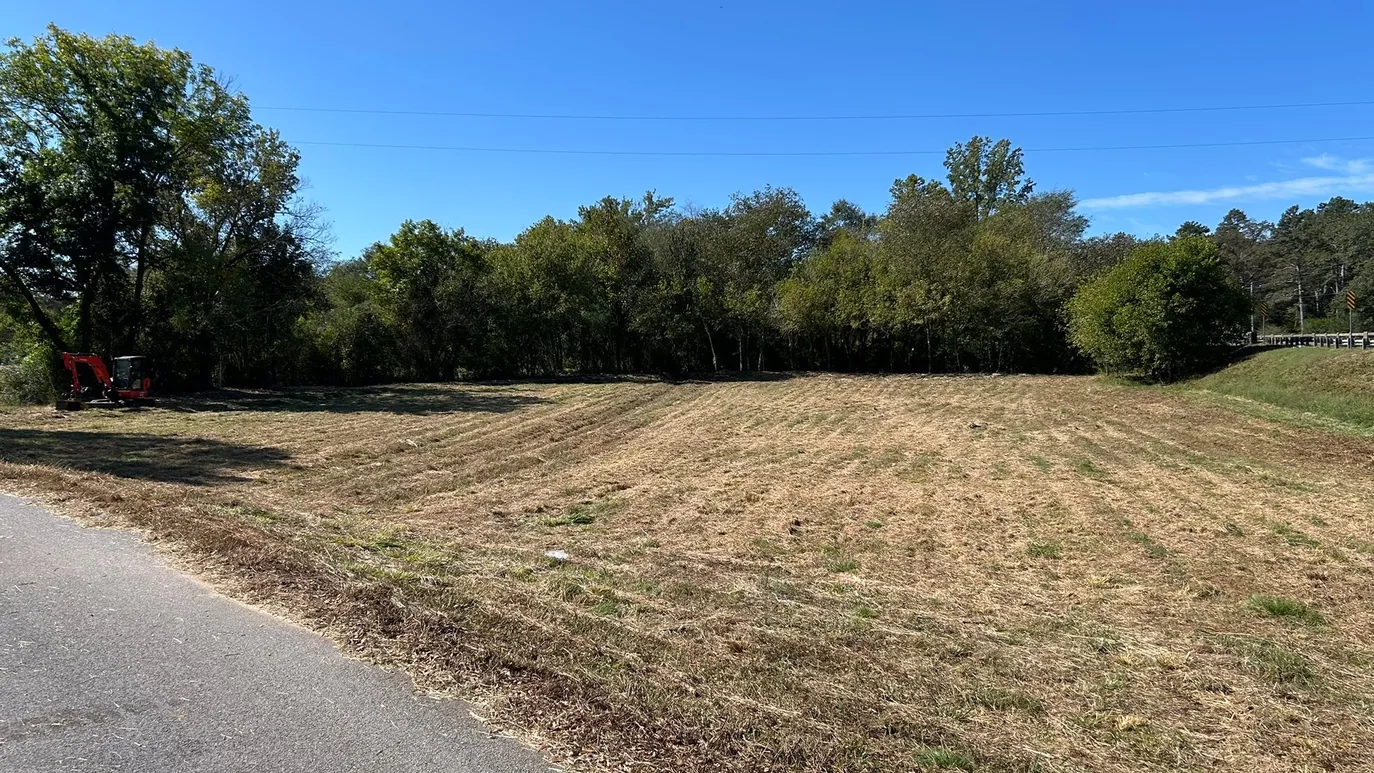
Those are national numbers, and Georgia jobs are priced on the same factors. Density, tree size, slope, access and acreage move the price the most. For forestry mulching, we run a mulching head on a track loader and on a mini excavator. The mulch stays on the ground instead of going to a burn pile or a truck.
What do national cost guides say forestry mulching costs?
National cost guides report the work several ways. Their hourly and daily rates include the machine and its operator.
| How it is priced | Published range |
|---|---|
| Per acre, light to typical brush | $400 to $1,500 |
| Per acre, thick growth and bigger trees | Up to about $2,500 |
| Per hour, machine and operator | $125 to $400 |
| Per day, machine and operator | $1,000 to $2,500 |
| Minimum charge on a small job | $400 to $600 |
| Setup or mobilization fee | $150 to $300 |
The guides do not agree, and the spread is wide. Two guides updated in 2026 break it out by job size.
| Job size | One national guide | A second national guide |
|---|---|---|
| Half acre | $200 to $750 | $1,000 to $1,400 |
| 1 acre | $400 to $1,500 | $1,200 to $2,500 |
| 5 acres | $2,000 to $7,500 | $5,000 to $10,000 |
| About 10 acres | $4,000 to $15,000 | $9,000 to $20,000 |
Both guides say bigger jobs cost less per acre. Setup costs spread across more ground.
What makes one acre cost more than another?
Mulching is priced on machine time, so anything that slows the machine raises the price. A USDA Forest Service bulletin says mulching costs swing with the equipment, the terrain, the site and operator skill.
How thick is the growth?
Light brush and briars mulch fast. A thicket of privet and saplings tangled in vines takes longer. One national guide lists $125 to $200 an hour for underbrush and small trees. It lists $300 to $400 an hour for heavy brush with large mature trees.
How big are the trees?
Bigger stems take longer to grind. In the federal bulletin, an operator says stems over about 6 inches thick are slow and costly to mulch. Felling and removing big mature trees is work for a tree service, quoted separately.
How steep and rough is the ground?
The same bulletin warns that output drops fast on steep, rough ground. Rocky spots and soft, wet ground slow a machine too. Our mini excavator runs a mulching head on slopes and ditch lines a track loader cannot reach.
Can the machine get to the work?
The machine comes in on a trailer, then has to reach the brush. One national guide lists extra fees when fences have to come down for access. It also lists travel fees for sites outside a company’s usual area.
How many acres are there?
Moving a machine to the site costs about the same for one acre or ten. A small job also often carries a minimum charge. That is why a half acre can cost more per acre than ten acres.
What happens to the debris?
Mulching turns brush into a mulch layer on site. One national guide counts that as a savings, since there is no debris to remove. When debris has to leave the site, another guide lists hauling at $300 to $1,000 per load.
How many trees stay, and how fine is the finish?
Working around many trees you want to keep takes more time, one guide says. That is the idea behind underbrushing, where the canopy stays and the undergrowth goes. A finer finish takes extra passes, and extra passes add hours. Clearing a food plot or a hunting trail is priced on these same factors.
Does mulching cost less than bulldozing and burning?
Often, yes, though the two methods leave the ground in different shape. One national guide puts clearing land for construction at $733 to $2,333 per acre in light woods. Heavy woods run $3,395 to $6,155 per acre in that guide.
The same guide puts forestry mulching near $400 per acre on average. It calls mulching the better fit if you do not plan to grade or dig right away.
A bulldozer pushes trees over and pulls the roots out of the ground. The brush and logs end up in machine-built piles. Those piles then get burned or trucked off, and each step adds cost.
In Georgia, burning those piles takes a burn permit from the Georgia Forestry Commission. A permit is good only for the day it is issued. A 2021 state law change dropped the permit for hand-piled yard debris, but machine-piled land-clearing debris still needs one.
The calendar limits burning too. State rules ban land-clearing burns May 1 through September 30 in 54 counties, including Banks, Hall, Jackson and Lumpkin. Hall County also bars open land-clearing burns from October through April. Counties and cities can add stricter rules, and the state suggests checking with the local fire marshal.
Habersham County, for one, requires the fire chief’s approval and an air curtain burner for a land-clearing burn. Its permit for a burn in a residential area is $250 per burner.
Mulching skips the piles. The brush becomes a mulch layer that stays on the ground and covers the soil. One national guide lists erosion prevention and undamaged topsoil among its benefits.
A bulldozer still has its place. Root removal can matter under a house pad or a road bed. For a new home, our site preparation clears the house spot and the drive around the trees you keep.
What should a written forestry mulching quote cover?
A written quote should spell out these items:
- The area. The acres or the flagged lines, and which trees stay.
- What gets mulched. The kinds of growth, and the largest stem size included.
- The finish. How fine the mulch is, and how many passes it takes.
- Stumps. Mulching leaves them at or near the ground. Grinding them below grade is work for a stump grinding company, quoted separately.
- Access. How the machine gets in, plus any travel or setup fee.
- Permits. Georgia’s erosion rules can require a land disturbance permit at one acre or more. Work within 200 feet of a stream can need one at any size. Your county or city office, or Georgia EPD, says whether a job needs one.
- Utilities. Any digging or grading needs a Georgia 811 ticket at least 3 business days ahead. Utility members do not mark private lines, such as a line to a barn or a well. Point those out before work starts.
How do you get a forestry mulching price for your land?
Wall Land Solutions mulches brush and small trees across Northeast Georgia, about 60 miles around Toccoa. See how our forestry mulching service works, then call or text (678) 776-8002 for a free estimate. We look at the land and put the quote in writing.